
Understanding Cash Value in Life Insurance
- Amber. C
- Feb 2
- 4 min read

Cash value is one of the most misunderstood aspects of life insurance. Some people assume it works like a savings account, while others believe it guarantees strong investment returns. In reality, cash value serves a very specific role within certain types of life insurance policies — and understanding that role is essential.
This guide explains what cash value is, how it works, and what it can (and cannot) be used for.
What Cash Value Is
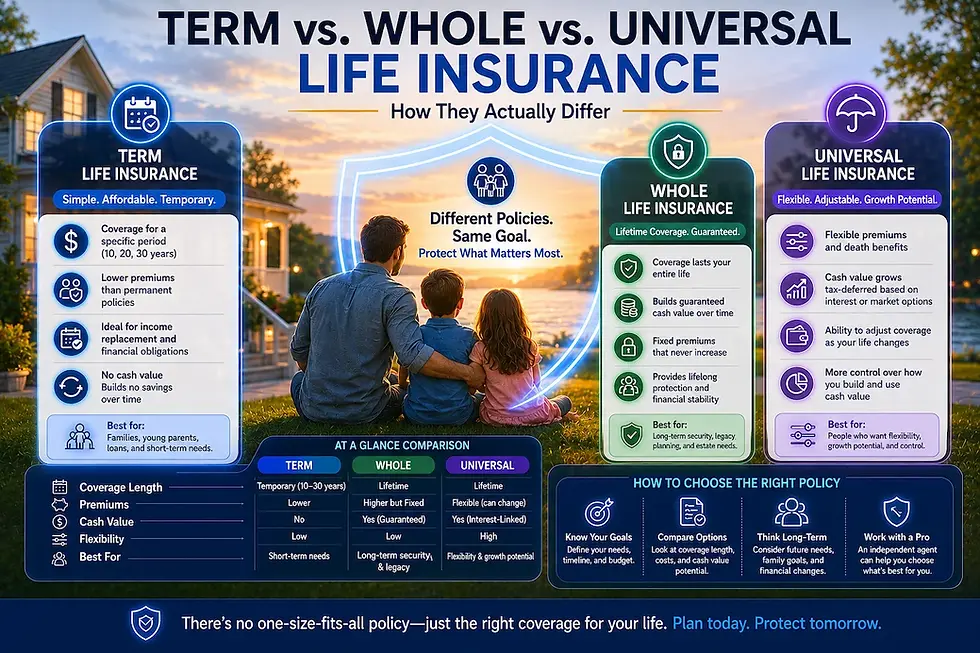
Cash value is a component found in permanent life insurance policies, such as whole life and universal life insurance. It represents a portion of the premiums paid that accumulates inside the policy over time.
Term life insurance does not have cash value.
Cash value exists alongside the death benefit and grows according to the rules set by the policy.
When Cash Value Actually Matters (and When It Doesn’t)
Cash value life insurance isn’t automatically better or worse than term life insurance — it depends on why you’re buying coverage in the first place.
Cash value tends to matter more when:
You expect to keep the policy long-term (10+ years)
You want the option to borrow against the policy later
You’re using life insurance as part of a broader financial plan
Cash value usually matters less when:
You only need coverage for a specific time period
Your main goal is income replacement at the lowest cost
You don’t plan to access the policy while you’re alive
Understanding this distinction helps avoid paying for features you may never use.
How Cash Value Builds Over Time
Cash value growth is not immediate. In the early years of a policy, a significant portion of premiums goes toward:
Policy expenses
Insurance costs
Administrative fees
As the policy matures, cash value typically begins to grow more noticeably.
The rate and structure of growth depend on the type of policy:
Whole life policies usually grow at a guaranteed rate
Universal life policies grow based on interest rates or indexes, depending on design
Real-World Example: Using (and Not Using) Cash Value
Consider two people buying life insurance at age 35:
Person A chooses a permanent life policy and builds cash value over time. At age 50, they borrow against the policy to cover a temporary income gap after changing careers.
Person B chooses term life insurance, pays lower premiums, and invests the difference elsewhere. They never need to borrow against a policy but maintain coverage while their family depends on their income.
Neither choice is universally right or wrong — the difference comes down to how the policy fits into each person’s financial situation.
What Cash Value Can Be Used For
Cash value is not just a number on a statement — it can be accessed in certain ways.
Policy Loans
Many policies allow the policyholder to borrow against the cash value.
Key points:
Loans are not taxable if structured properly
Interest is charged by the insurer
Unpaid loans reduce the death benefit
Withdrawals
Some policies allow withdrawals from the cash value.
Important considerations:
Withdrawals may reduce the death benefit
Excess withdrawals can cause a policy to lapse
Tax treatment depends on policy structure
Premium Payments
In some cases, cash value can be used to help pay premiums.
This can be useful later in the policy’s life, but it requires careful management to avoid unintended consequences.
What Cash Value Is Not
Cash value is often misunderstood as an investment or savings account. It’s important to understand its limitations.
Cash value is not:
A high-yield investment
Fully liquid without consequences
Guaranteed to grow quickly
Separate from the life insurance policy
Its purpose is to support the policy — not replace traditional savings or investment strategies.
How Cash Value Affects Policy Cost
Permanent life insurance policies cost more than term life insurance in part because of the cash value component.
Premiums are higher because they fund:
Lifetime coverage
Policy guarantees
Cash value accumulation
Understanding this trade-off helps explain why permanent policies are structured differently from term policies.
Common Cash Value Misunderstandings
Some common assumptions include:
Cash value can be accessed freely at any time
Cash value equals the death benefit
Cash value growth is always guaranteed
Cash value performs like market investments
These misunderstandings often lead to unrealistic expectations.
Why These Misunderstandings Matter
These assumptions often lead people to choose policies that don’t match their actual needs.
For example:
Expecting fast cash value growth can result in frustration during the early years of a policy.
Treating policy loans as “free money” can unintentionally reduce the payout beneficiaries receive.
Assuming all permanent policies work the same way can cause cost and performance surprises later.
Understanding these limits helps set realistic expectations before choosing a policy.
How Cash Value Fits Into a Broader Plan
Cash value can play a role in long-term planning, but it works best when it aligns with specific goals.
It may be used to:
Provide policy flexibility
Support long-term coverage needs
Offer controlled access to funds under certain conditions
Its usefulness depends on how the policy is structured and maintained over time.
Key Takeaways
Cash value exists only in permanent life insurance
Growth depends on policy type and structure
Loans and withdrawals affect the death benefit
Cash value supports the policy, not replaces investments
Understanding limits prevents costly mistakes
Cash value is a tool within life insurance — not a shortcut to savings or investing. When understood correctly, it helps explain why permanent policies are designed the way they are.
Check out our Amazing!


Comments