
Term vs. Whole vs. Universal Life Insurance: How They Actually Differ
- Amber. C
- Feb 1
- 3 min read
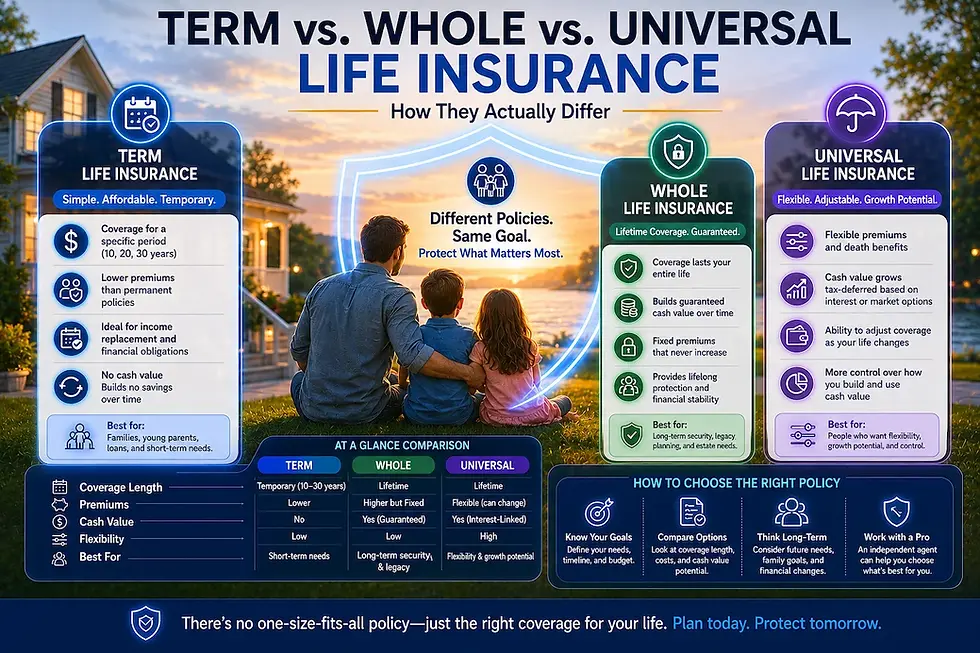
Life insurance is often discussed as if it’s a single product, but in reality there are several distinct types — each designed for different goals, time horizons, and financial situations.
The three most common types are term life, whole life, and universal life insurance.
This guide explains how each type works, how they differ, and how to think about them in practical terms.
What Term Life Insurance Is
Term life insurance provides coverage for a specific period of time, such as 10, 20, or 30 years.
If the insured person dies during the term, the policy pays a death benefit to the beneficiaries. If the term expires and the insured is still living, the policy ends unless it is renewed or converted.
Key characteristics of term life insurance:
Coverage lasts for a set period
No cash value component
Generally lower premiums
Designed for temporary financial needs
Term life insurance is often used to cover income replacement, mortgages, or other obligations that decrease over time.
What Whole Life Insurance Is
Whole life insurance is a form of permanent life insurance, meaning it is designed to last for the insured’s entire lifetime, as long as premiums are paid.
In addition to a death benefit, whole life insurance includes a cash value component that grows over time at a rate defined by the policy.
Key characteristics of whole life insurance:
Lifetime coverage
Fixed premiums
Guaranteed cash value growth
More expensive than term life
Whole life insurance is typically used when long-term coverage and predictability are priorities.
What Universal Life Insurance Is
Universal life insurance is also a type of permanent life insurance, but it offers more flexibility than whole life.
Universal life policies allow policyholders to adjust premiums and death benefits within certain limits. Cash value growth is tied to interest rates or indexes, depending on the policy type.
Key characteristics of universal life insurance:
Lifetime coverage
Flexible premiums
Adjustable death benefit
Cash value growth varies by policy design
Universal life insurance is often used when flexibility is more important than fixed guarantees.
Key Differences Between Term, Whole, and Universal Life
Coverage Duration
Term: Temporary
Whole: Lifetime
Universal: Lifetime
Cash Value
Term: None
Whole: Guaranteed growth
Universal: Variable or interest-based growth
Cost
Term: Lowest initial cost
Whole: Higher, fixed premiums
Universal: Varies based on funding and structure
Flexibility
Term: Limited
Whole: Minimal
Universal: High
How People Actually Choose Between These Policies
In practice, most people don’t choose between term, whole, and universal life by comparing features alone. The decision usually starts with why coverage is being purchased.
Term life is commonly chosen when:
Coverage is needed for a defined time period
The primary goal is income replacement
Budget flexibility is important
Whole life is commonly chosen when:
Coverage is intended to last indefinitely
Predictable premiums and guarantees matter
The policy is part of a long-term financial plan
Universal life is commonly chosen when:
Flexibility in premiums or death benefits is a priority
Cash value growth is a consideration
Ongoing policy monitoring is acceptable
These patterns help explain how each policy type is typically used, rather than suggesting that one option is universally better than another.
How to Think About Choosing Between Them
The “best” type of life insurance depends on why the coverage is needed.
Temporary needs often align with term life
Long-term or estate-related needs may point toward permanent coverage
Flexibility and long-term planning considerations can make universal life appealing
Understanding how each policy works is more important than focusing on labels or assumptions.
Common Mistakes When Comparing Life Insurance Types
Comparing life insurance options can be misleading when differences in structure are overlooked.
Common mistakes include:
Focusing only on monthly cost without considering how long coverage lasts
Assuming cash value works the same way across policies
Comparing policies without aligning them to the underlying need
Understanding these distinctions helps prevent confusion when reviewing policy options or comparing quotes.
Key Takeaways
Term life is temporary and straightforward
Whole life offers lifetime coverage with guarantees
Universal life prioritizes flexibility
Each type serves different financial purposes
Comparing structure matters more than comparing names
Life insurance works best when it aligns with actual needs, not just general recommendations.
Check out our Amazing!


Comments