Disclaimer: We share general insurance tips and insights — not licensed advice. Always check with a qualified insurance professional before making decisions. See full Disclaimer.

Insurance Policy Authority
Insurance advice for auto, home, and life.
Homeowners Insurance: Covered Perils, Coverage Scope & Deductibles
Covered Perils & Coverage Scope
(OCT Section 5)
Coverage limits tell you how much a policy can pay.
Perils and coverage scope determine when it will pay.
This section explains why many claim denials happen even when limits appear adequate.
Open Perils vs. Named Perils
Homeowners policies generally cover losses in one of two ways:
-
Open Perils (All-Risk)
Covers all causes of loss except those specifically excluded -
Named Perils
Covers only the causes of loss explicitly listed in the policy
This distinction applies separately to:
-
The dwelling
-
Personal property
For example, a policy may provide:
-
Open-peril coverage for the dwelling
-
Named-peril coverage for personal property
That difference has real consequences during a claim.
Why This Distinction Matters
With named-peril coverage:
-
The burden is often on the policyholder to show the loss is covered
-
Losses caused by unlisted events are excluded by default
With open-peril coverage:
-
The insurer must rely on exclusions to deny coverage
Two policies with identical limits can produce opposite outcomes depending on how perils are defined.
When filling out the OCT:
-
Record whether dwelling coverage is open or named peril
-
Record whether personal property coverage is open or named peril
Exclusions Are as Important as Coverages
Exclusions define what a policy will not cover, even if damage is severe.
Common exclusions include:
-
Flood
-
Earthquake
-
Wear and tear
-
Certain water-related losses
-
Neglect or deferred maintenance
Exclusions often explain why policyholders say:
“I thought I was covered for that.”
When reviewing offers:
-
Look for exclusions that affect your geographic area or home features
-
Note any exclusions that significantly narrow coverage
This section of the OCT is where you document those limitations.
Why This Section Matters
Coverage scope determines whether insurance responds at all.
A policy with lower limits but broader coverage may provide better real-world protection than a higher-limit policy with restrictive perils and exclusions.
This section ensures you evaluate coverage behavior, not just coverage size.
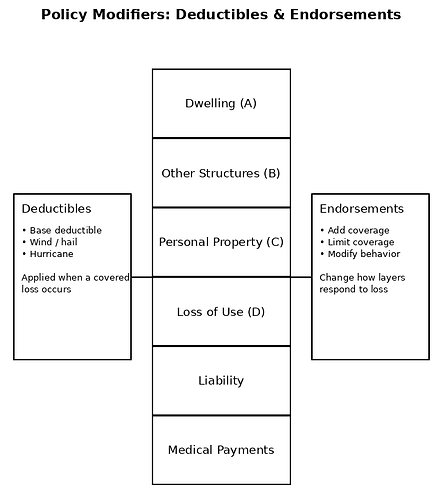
Deductibles by Event
Deductibles determine how much financial responsibility you retain when a loss occurs.
They do not change whether a loss is covered — they change how expensive the loss is for you.
Base Deductible
The base deductible applies to most covered losses.
A higher deductible:
-
Lowers premium
-
Increases out-of-pocket cost
A lower deductible:
-
Raises premium
-
Reduces out-of-pocket exposure
At this stage, the deductible should be evaluated alongside coverage limits, not in isolation.
Event-Specific Deductibles
Many homeowners policies include separate deductibles for specific events, such as:
-
Wind
-
Hail
-
Hurricanes
These deductibles may be:
-
Flat dollar amounts
-
Percentages of the dwelling limit
Percentage-based deductibles can result in significant out-of-pocket costs after a major loss.
When completing the OCT:
-
Record each deductible separately
Note whether it is flat or percentage-based
Why Deductibles Are Often Misunderstood
Deductibles are frequently misunderstood because:
-
They are discussed primarily as a pricing tool
-
Their real financial impact is not obvious until a claim occurs
Two policies with the same premium and limits can expose homeowners to very different costs due to deductible structure alone.
Why This Section Matters
Deductibles determine how much risk you retain, not how much insurance you buy.
Understanding deductibles by event prevents surprises at the worst possible moment — after a loss has already occurred.
This section ensures deductible decisions are intentional, not accidental.
What Comes Next
Only one section remains, and it completes the evaluation process:
-
Section 6: Endorsements, Notes & Comparing Offers