
Does Car Insurance Cover Hit-and-Run Accidents?
- Anthony. M
- Apr 10
- 3 min read
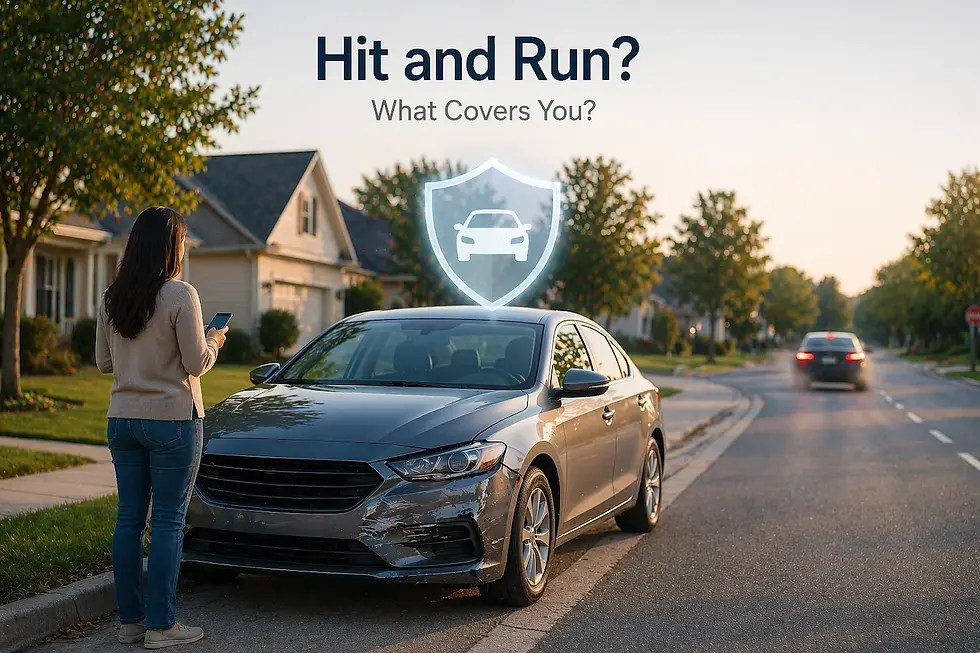
What Protection Applies When the Other Driver Leaves
A hit-and-run accident can be one of the most frustrating situations a driver faces.
You return to your car and find damage — or worse, you’re involved in an accident and the other driver leaves the scene. In both cases, there’s one immediate question:
Who pays for the damage?
From an insurance standpoint, hit-and-run accidents are treated differently than standard accidents because the at-fault driver cannot be identified.
That means your own insurance coverage often becomes the primary source of protection.
What Is a Hit-and-Run Accident?
A hit-and-run occurs when a driver involved in an accident leaves the scene without providing contact or insurance information.
This can happen in different ways:
A parked car is damaged and the driver leaves
A driver causes an accident and drives away
A vehicle makes contact and disappears before being identified
In all of these situations, the key issue is the same:There is no known at-fault driver to file a claim against.
What Coverage May Apply
Even though the other driver is unknown, certain types of insurance coverage may still help.
Uninsured Motorist Coverage
Uninsured motorist (UM) coverage is often the most relevant in hit-and-run situations.
This coverage is designed to protect you when:
The other driver has no insurance
The other driver cannot be identified
Depending on your policy, it may help cover:
Medical expenses
Injury-related costs
In some cases, it may also extend to vehicle damage, depending on how your policy is structured.
Collision Coverage
Collision coverage may help pay for damage to your vehicle after a hit-and-run.
This applies whether:
The other driver is known
The other driver is unknown
However, collision coverage typically involves paying your deductible before insurance covers the remaining cost.
What Usually Does Not Apply
It’s important to understand what typically does not cover hit-and-run damage.
Liability insurance does not apply, since it covers damage you cause to others
Comprehensive coverage usually does not apply, as it is designed for non-collision events
Understanding these limits helps avoid confusion during an already stressful situation.
What to Do Immediately After a Hit-and-Run
If you are involved in a hit-and-run, taking the right steps can make a difference.
1. Check for injuries
Your safety comes first. If anyone is injured, seek medical attention immediately.
2. Document the scene
Take photos of:
Vehicle damage
Surrounding area
Any debris or evidence
3. Look for information
If possible, note:
Vehicle description
Direction the other driver traveled
Witness information
4. Report the incident
Filing a police report is often important for insurance claims, especially in hit-and-run cases.
5. Contact your insurance provider
Notify your insurer as soon as possible to begin the claims process.
Real-World Scenarios
Scenario 1: Parked Car Damage
You come out of a store and find your car damaged with no note left behind.
In this case:
Uninsured motorist coverage may apply (if included in your policy)
Collision coverage may also apply
Without these coverages, you may need to pay for repairs yourself.
Scenario 2: Hit While Driving
Another driver sideswipes your vehicle and drives away.
In this situation:
Your uninsured motorist coverage may help with injuries
Collision coverage may help repair your car
Again, your own policy becomes the primary source of protection.
Financial Considerations
Hit-and-run accidents can create unexpected costs, including:
Vehicle repairs
Medical expenses
Lost time or income
Having the right coverage in place can significantly reduce the financial impact.
Without it, even a minor incident can lead to out-of-pocket expenses.
How to Protect Yourself Ahead of Time
While you can’t control other drivers, you can prepare for situations like this.
Consider:
Adding uninsured motorist coverage
Including collision coverage if your vehicle has value
Reviewing your deductible to ensure it fits your budget
These steps can help ensure you’re not left unprotected.
A Simple Way to Think About It
In a hit-and-run, the usual process of filing a claim against the at-fault driver isn’t possible.
Instead, your own coverage steps in — if you have the right protection in place.
Bottom Line
Car insurance may cover hit-and-run accidents, but it depends on the types of coverage included in your policy.
Uninsured motorist coverage and collision coverage are often the key components.
Understanding how they work can help you prepare for situations where the other driver cannot be held accountable.
Important Note
This article is for informational purposes only and should not replace the terms of your actual insurance policy.
Written by Anthony M., insurance research contributor focused on auto insurance at Insurance Policy Authority.
Like what you see here? Then...
Check out our Amazing!


Comments